Wednesday, 2 September 2015

Cycling the Sjuharadsrundan

Sweden is a wonderful destination for easy cycle touring.  The main problem is knowing the best routes and getting enough information to plan to the trip in advance.

A few years ago we cycled part of the Gota Canal which was very pleasant, so this year I decided to plan another cycle touring trip to Sweden.  After some Googling, I came across the Sjuharad Bike trail: http://cykelledensjuharadsrundan.se/en/.   This is a circular route of 150km of generally well signposted mainly traffic free cycle paths.  Most of it is on disused railway lines, through forests and around lakes, with a small part on minor roads.

The above website gives you quite a bit of information about the bike trail itself, but it doesn't list accommodation or where to hire cycles.  Fortunately in Sweden many campsites have stugas - cabins which are like micro-youth hostels - you just need to bring a hostel sheet and everything else is provided (cutlery, plates, cooking facilities, duvets etc).  You normally have to clean the stuga afterwards and they provide you with a hoover and mop and bucket.

After some more googling we established that there is a big campsite at Boras (one of the starting points of the trail) which has both stugas and a youth hostel.  You can get to Boras easily by train or bus from Gothenburg (around a hour).  We stayed at the youth hostel at Boras Camping, then a stuga in Prangens Camping at Ulricehamn, a youth hostel in Limmared and then another stuga in Svenljunga Camping, before finally cycling back to Boras for another night at the youth hostel in Boras Camping

As it can be difficult and expensive (although not impossible) to take bicycles on flights, the next thing we needed somewhere to hire bicycles.  There is only one cycle hire place in Boras but they have a very wide selection of used bikes:  mountain bikes, road bikes, hybrids, dutch style sit up and beg bikes.   They don't hire panniers so we brought our own and selected bikes with rear racks.  We found it was very important to choose bikes with working gears and brake before taking them (not all of the bikes were in a good state of repair).  If I was doing this again I would also bring some basic tools, although the bikes we chose were very well behaved on the tour so we were fine.

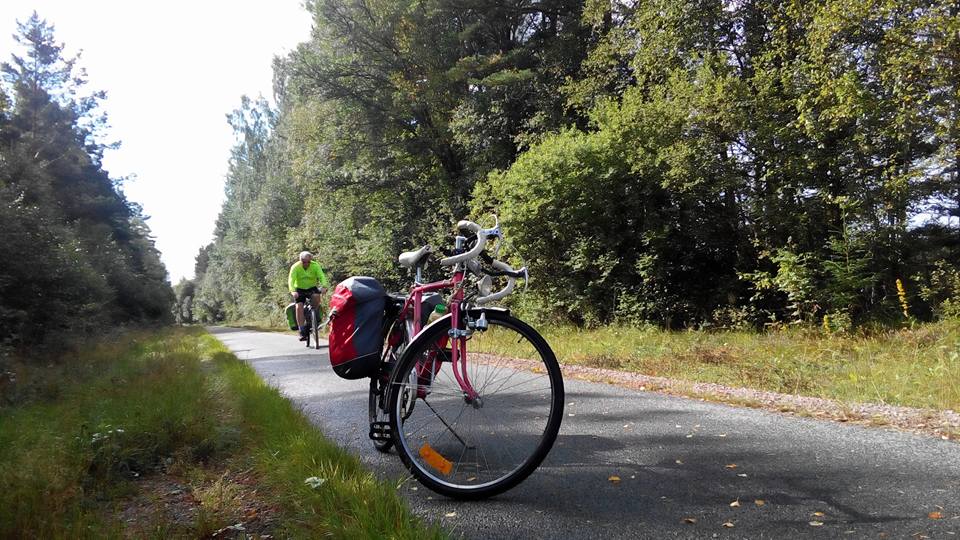
I chose a 6-speed road bike (2-speed derailier and a 3-speed hub), probably dating from the 1970s or 80s.  There are few uphill sections on this trail so the limited gearing wasn't too important.  This old bike really grew on me during the trip and I was sad to part of it at the end.  Centre pull brakes and "safety" brake levers - so iconic.

After finishing the Sjuharad cycle trail we caught the train back to Gothenburg and spent a few days sightseeing and visiting some of the nearby islands. A great way to finish the holiday.  You can get a City Card that covers buses, trams and ferries as well as providing free entrance to many museums.




Monday, 17 August 2015

Dog Days

To the ancient Greeks and Romans, dog days corresponded to the period in late summer when Sirius was visible above the horizon.  They believed that dog days were an unhealthy time of year, a time of heat, humidity, fever, and even war and disaster.

This year, I've spent part of the dog days in clearing out old papers that accumulate in cupboards and filing cabinets because I've never had the time or inclination to go through them.  I've also been giving away various pieces of furniture and kit I no longer use (with the help of Freegle and Streetlife).

In the process I've discovered that de-cluttering makes you feel good, as well as providing more space and making it easier find things, lost or forgotten, that are actually useful

Perhaps there is a metaphor here.  Our ideas and attitudes can become more cluttered as we get older to the extent that they can clog up our outlook on life.  If we suddenly we decide to just let useless things go, will we see the world more clearly?  Perhaps.


Sunday, 24 May 2015

Very Imp-ressive!

It is a while since I stayed up until the small hours of the morning just to finish a book, but I did last night.  I was reading Uma & Imp, a children's novel by Larisa Villar Hauser.

Uma & Imp is a rollicking mystery adventure story. The plot revolves around 11-year-old Uma's search for her parents who vanished in mysterious circumstances when she was four. Uma finds a clue to their disappearance hidden in an old photograph and is soon searching for an elusive Prof Harris. Unfortunately she quickly discovers that she is not the only one seeking him.

Aided, abetted and hindered in turn by the irrepressible Imp, Uma eventually locates Harris only to find sinister characters, El Jefe, Barrel and Stick are in hot pursuit. As the story unfolds we are riding a speeding rollercoaster of a plot which just gets faster and faster. 


The various twists, turns and narrow escapes are interspersed with humorous episodes involving either Imp or dotty Aunt Callista, making it a fun read as well as a cracking page-turner.  My favourite character is the puckish Imp who is plays the role of both mentor and mischief-maker to the more serious Uma.


I just hope there is a sequel as I'm really starting to miss Imp.  Should appeal to children aged anywhere between 9 and 90.


I've given it 5 stars and it has made it into my Top 100 children's books.

Thursday, 9 April 2015

Belated spring post.

I've not posted for a while, so there are lots of things I could talk about: my new double-glazing, new cooker (5th time successful!), progress with my dissertation  or other various projects that are still incubating,

But instead of any of that I am going to talk about...

Frog Sprawn
The frogs actually got busy in my pond a few weeks ago (see photographic evidence) but I talking about it now because it is one of signs of spring and this is a belated spring post.  I love everything to do with spring:  daffodils, trees in blossom, warmer weather, clocks going forward etc etc.

If you consider seasons to be archetypes, then spring symbolises the world waking up again after its long winter sleepover.   Yes, this may sound hackneyed but it is still true (or true for me anyway).


Saturday, 21 February 2015

Visit to a unique island

The island that won the George Cross for the bravery of its whole population, where the people speak the only semitic language in the EU.

It contains the world's oldest free standing structures, a thousand years older than the pyramids.

St Paul was shipwrecked here.

Tuesday, 13 January 2015

The iron men of Crosby Beach

On a short visit to Liverpool last week. We stayed at the iconic Adelphi Hotel and explored the city, port and museums and galleries including the Lady Lever Gallery at Port Sunlight.

One day we went for a walk among the Iron men of Crosby Beach.

Sunday, 11 January 2015

End of the year in the Cote D'Azure

We spent the last week of 2014 in Nice on the Cote D'Azure, a great destination for short breaks in winter.  There are lots of flights at reasonable prices and if you book well in advance you can also get good deals on train fares from London.

It is often very sunny in winter due to the local microclimate and there is an excellent and very cheap public transport system: trams, buses, SNCF trains and the only private railway in France - Nice to Dignes les Bains.  The latter is the surviving part of the once extensive Chemins de Fer de Provence.

There are coastal walks, walks in the hills, deserted hilltop forts and medieval villages with dark narrow streets which hide the sun.


Thursday, 4 December 2014

Autumn Dinosaurs


We've been walking with dinosaurs, the Crystal Palace dinosaurs to be more specific.

Crystal Palace is the oldest dinosaur park in the world (opened 1854, five years before Darwin's Origin of the Species).  These victorian dinosaurs are interesting for what they tell us about what mid-19th century scientists knew about dinosaurs.

The dinosaurs fell into disrepair after the five in 1936 that destroyed the Crystal Palace, but were restored in the 1950s and in 1973 they became Grade II listed.  After further restoration in 2002, they became Grade I listed in 2007.

The dinos look great with trees in autumn colours as you can see from the photos.

Tuesday, 11 November 2014

The Blood Swept Lands and Seas of Red

The Blood Swept Lands and Seas of Red is the title of the sea of ceramic poppies in the moat of the Tower of London.  It comes from a poem written by an anonymous soldier in the Great War, which ends:

I put my hand up and see the land of red,
This is my time to go over,
I may not come back
So sleep, kiss the boys for me


Today is Armistice Day and we went to see the poppies at the Tower of London.  It was a moving display and once again brought home how the poppy has endured as a symbol for war dead, particularly those who perished on the Western Front.

Poppies grow naturally in conditions of disturbed earth and were seen in large numbers on the battlefields of the Napoleonic Wars, and then a century later in the Great War.  The Canadian surgeon John McCrae wrote the famous poem, "In Flanders Fields", which linked the battlefield poppies to the graves of the fallen.

If ye break faith with us who die
We shall not sleep, though poppies grow
In Flanders Fields


Monday, 6 October 2014

Getting in touch with my inner Tarzan

Yesterday 7 of us did the Go Ape course at Trent Country Park in North London.  It was an amazing experience.

In case anyone is not familiar with Go Ape, it is a sort of aerial obstacle course or high ropes forest adventure, that sort of thing.

After getting kitted up with sit harnesses and karabiners and then having our introductory training, we were ready to tackle the course.  Well sort of ready - we didn't know what to expect.

The zip wires were exhilarating, especially the skateboard zip and long final one.  The Tarzan swings were exhausting, and those swinging rope steps and swaying barrels were just horrible.

After finishing the course, we went to the cafe for coffee and cakes and then went for a stroll to see the old Sassoon mansion, now part of Middlesex University.  But we were in for a shock - the university's iconic Trent Park campus is now derelict.  The students have gone and the buildings empty and fenced off from the rest of the park by tape and fences.

Saturday, 13 September 2014

Sound mirrors

As no one correctly guess the purpose of the concrete defence structures, I going to tell you.

The cylindrical tower shown in the first photo of my earlier post is a Martello Tower .  Martellos are small defensive forts built in the early 19th century and there are quite a few on the south and east coast

However the other structures are more interesting and much rarer.   These are sound mirrors.

The sound mirrors were built in the late 1920s and early 1930s as an experimental early warning system of enemy aircraft.  Several were built on the south and east coast, but the complex at Denge is the best preserved.

As shown in the photos, there are three sound mirrors at Denge:  a 200ft curved wall, a 30ft circular dish with a metal microphone pole in its centre (which is seen in the photo), and a smaller shallower 20ft dish.

Sound mirrors were effective at detecting slow moving aircraft long before they came in sight.  The sound of aircraft engines was concentrated at the focus of the mirror where a microphone was located.

Sound mirrors became less useful as aircraft became faster and they finally became obsolete after radar was invented.  The experiment was abandoned prior the Second World War and the sound mirrors were left to decay.


Sunday, 7 September 2014

Old defence structures on remote Kent coast

These buildings pre-date radar.  Can you work out what might have been their function?   The shape might give you a clue.  Ask your friends and family?

They are made of concrete and do not involve radio waves or any other form of electromagnetic radiation.  I will reveal the answer and tell you about their history in my next post.


Thursday, 4 September 2014

Can you guess what these are?

We've returned from a few lovely sunny few days in a remote unspoilt part of Kent.

We took loads of photos, but before I tell you more about the trip, you might like to guess what this is:


OK That was the easy one, but it gets harder now.   What are these structures then? 


Sunday, 17 August 2014

Another bout in hospital

You may have noticed that I've not posted much in the last few weeks.  Part of the reason has been that I've had another wound infection and had to go back into hospital for another debridement.


It turned out there had been tunneling and undermining of my wound.  A structural engineering problem?  As far as I can make out, it is a bit like that.  There is a cavity underneath the regrown tissue my wound.  Just as well, there wasn't a cave in or roof collapse.

Anyway after 5 nights in hospital I was discharged with a vac dressing and antibiotics.   I hope this means that my wound will finally close soon.  It has been going on for far too long.


Wednesday, 30 July 2014

354 and the the nature of coincidence

I've just finished reading "She is Not Invisible" by Marcus Sedgwick.  I almost didn't read it because I'd previously tried to read "White Crow" by the same author and given up part way through - it was sooo boring.

"She is Not Invisible" is the complete opposite - a real page turner.  There was no way I was not going to finish this book, and quickly too.

It is the story of Laureth, her young brother Benjamin and a toy raven called Stan, who decide to fly to New York while their mother is away for the weekend.  Someone has found their father's notebook in New York, when he was supposed to be in Switzerland and he's not answering his phone.  Laureth thinks he must be in trouble and persuades her 7-year-old brother to travel with her on a hair-brained but spirited mission to rescue him.

They meet up with the mysterious Mr Walker who found the notebook, and follow a trail of clues (some true some false) to their father's whereabouts, encountering some unusual locals along the way, some more helpful than others.

What's this got to with 354 and the nature of coincidence?  Laureth's father was obsessed with both, and this provides another dimension to this story.

The characters, particularly the protagonist Laureth, are engaging and likeable.  The only thing I wasn't sure about was the ending, but I won't reveal it here.

I've given this story 4 stars.

Sunday, 13 July 2014

Travelling on the Petworth Pullman

We spent a few nights at the Old Station B&B at Petworth in Sussex in one of the their restored Pullman carriages, Mimosa which was built in 1914.

Pictures convey the experience far more than words.


Wednesday, 25 June 2014

Another lost railway walk in North London

Last Wednesday evening we set off on this 4 mile country walk in north London. It is nearly all on paths other than a small section in Hendon.

We started from Brent Cross tube and walked to Mill Hill East tube via various parks, a 13th Century church, Sunny Hill (magnificent views), Copthall Fields (once the great park of an old mansion), and a disused railway (Copthall Railway walk). The latter has an interesting history - well those of us who like old railways find it interesting.

A tiny bit of history
The Copthall Railway walk was part of the old Finchley Central to Edgware steam train line constructed in 1872. In the 1930s there was a plan to electrify the line and convert to to a tube (part of the Northern Line). However electrification was completed only as far as Mill Hill East before the plan was abandoned in the 1950s. This is why the Northern line has a odd single track one station spur called the Mill Hill East branch. The remaining line continued to be used for goods trains until the 1960s when the tracks were lifted.

And here is a photo of one of its old railway bridges:


Bury Abbey Gardens...

...was where we were a couple of weeks ago.  And where I took this photo.


Sunday, 22 June 2014

Demons of Ghent - a supernatural thriller with intriguing subplots.

I've just finished reading Helen's Grant's latest book - The Demons of Ghent - the second novel in her Silent Spaces Trilogy.  I mainly borrow from my local library, but I decided to buy this one rather than wait for it to appear in the library.

Veerle is now living in Ghent, but finds it hard to settle down to a new school and life with her father and his unsympathetic partner.  She makes friends with Bram, a local boy, who introduces her to his hobby - climbing and exploring the rooftops of Ghent.  He tells her about a local legend involving a old painting, demons on the rooftops and some long undead local citizens

After hearing about several unexplained deaths, Veerle and Bram witness the murder of one of Bram's friends on the rooftops.  As well as danger from whoever or whatever is stalking the streets and rooftops, Veerle's escapades bring her into conflict with her family and also with her boyfriend Kris.

The book is a little slow at the start, but the tension gradually builds to a white knuckle climax.  Veerle's complicated personal life adds another dimension to the plot which keeps the pages turning.

Despite not being quite as good as the first novel in the trilogy (Silent Saturday), this book is a great read for anyone who likes creepy YA fiction with strong characterisation.

Wednesday, 11 June 2014

Weird rock formations - where and what?

In a later post I will tell you where these pictures were taken and what caused these weird stoney structures.

In the meantime would anyone hazard a guess?  And no, it isn't Easter Island...